
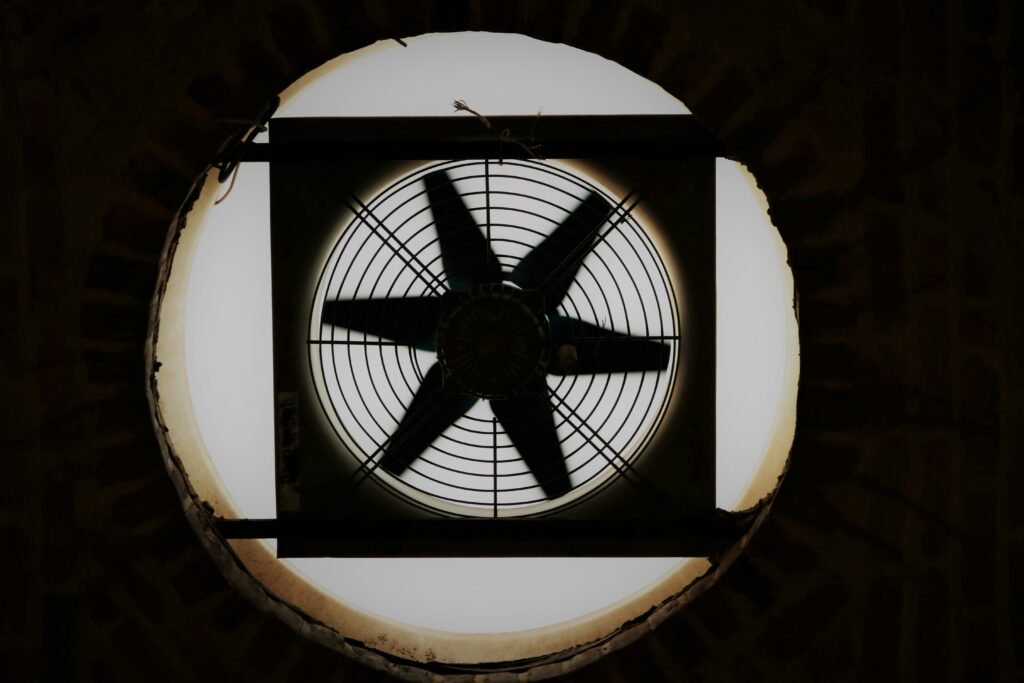
Commercial and industrial buildings generate substantial amounts of heat, moisture, airborne contaminants, and stale air. Without an effective ventilation strategy, these conditions can affect indoor comfort, equipment performance, building materials, and workplace conditions. Roof exhaust fans provide a practical way to remove unwanted air from large facilities by drawing it upward and discharging it outside. Unlike smaller residential ventilation equipment, commercial and industrial roof exhaust systems must account for building size, airflow requirements, operating conditions, ductwork, environmental exposure, and energy use. Selecting and installing the right system therefore requires more than simply choosing a fan with a high airflow rating.
Why Roof Exhaust Fans Matter in Large Buildings
Heat naturally rises, which makes the roof an effective location for exhausting warm and contaminated air. In manufacturing plants, warehouses, commercial kitchens, workshops, agricultural buildings, and other large facilities, internal heat can accumulate quickly, particularly around machinery, production areas, and poorly ventilated spaces. Roof exhaust fans help remove this air and create a controlled pathway for replacement air to enter the building.
The primary purpose is not simply to make a facility feel cooler. Mechanical exhaust can help control humidity, airborne pollutants, odors, fumes, and excessive heat. For example, a production process that releases moisture may create condensation if humid air remains trapped inside. Similarly, equipment that generates significant heat can raise temperatures beyond comfortable or suitable operating conditions.
Industrial ventilation should be designed around the actual source and type of contaminant. General exhaust ventilation can dilute and remove unwanted air throughout a space, while local exhaust ventilation is often more appropriate when contaminants are generated at a specific workstation. Roof exhaust fans can form part of either strategy, depending on the facility’s layout and ventilation design.
Choosing the Right Fan for Airflow Requirements
Airflow is one of the most important factors when selecting a roof exhaust fan. A fan must move enough air to meet the building’s ventilation requirements without creating unnecessary energy consumption or excessive noise. Simply choosing the largest available fan is not an effective design approach because airflow performance depends on system resistance, ductwork, louvers, dampers, filters, and other components.
Facilities evaluating equipment from suppliers such as the ventilation supplier should consider the fan’s rated airflow alongside its performance under actual static pressure conditions. A fan may advertise a substantial cubic-feet-per-minute capacity under ideal conditions, but its delivered airflow can be lower once connected to ductwork or other restrictive components.
Fan type also matters. Axial fans can move large volumes of air and are commonly used where relatively low static pressure is involved. Centrifugal fans, by contrast, are generally better suited to systems requiring higher static pressure because of ductwork, filters, or other resistance. Direct-drive and belt-drive configurations offer different maintenance and operating characteristics, so the appropriate choice depends on the facility’s requirements.
Motor, Construction, and Environmental Considerations
The fan itself is only one part of a reliable roof ventilation system. Motor selection, construction materials, controls, and environmental protection all influence long-term performance. A commercial facility may operate ventilation equipment for many hours each day, making motor efficiency and durability important considerations.
When reviewing options from Industrial Fans Direct, facility managers should also examine whether the fan’s construction is appropriate for its environment. A dry warehouse has very different requirements from a food-processing facility, chemical-handling area, or manufacturing plant exposed to corrosive vapors. Galvanized steel, aluminum, stainless steel, protective coatings, and other construction options may be appropriate depending on exposure.
The motor enclosure should likewise correspond with operating conditions. Outdoor roof installations are exposed to rain, temperature changes, sunlight, and wind. The equipment therefore needs appropriate weather protection and electrical characteristics for the installation environment. In specialized applications, additional considerations such as hazardous-location requirements may apply.
Controls are another important part of the system. Variable-speed drives, thermostats, pressure controls, occupancy controls, or building automation systems can allow ventilation to respond to changing conditions rather than running at full capacity continuously. Proper control can improve ventilation management while reducing unnecessary operating time.
Installation Factors That Affect Performance
Even a properly selected exhaust fan can perform poorly if it is installed incorrectly. Roof-mounted equipment must be positioned and supported appropriately, with attention given to structural loading, weather sealing, discharge location, and service access. The roof penetration should be carefully designed to prevent water intrusion, while the fan curb and flashing must be compatible with the roofing system.
The discharge point also deserves attention. Exhaust air should not be positioned where it can easily re-enter outdoor air intakes, doors, windows, or occupied areas. This is particularly important when the exhaust contains odors, moisture, fumes, or other contaminants. Building codes and applicable ventilation standards should be reviewed during system design.
Replacement air is equally important. Exhausting large quantities of air without providing an adequate path for makeup air can create negative pressure inside the building. That pressure can reduce fan performance, interfere with doors, pull contaminants into the facility, and increase the load on other mechanical systems. A balanced approach considers both exhaust and incoming air.
A practical installation review should address:
- Required airflow and static pressure
- Roof structure and weatherproofing
- Makeup-air requirements
- Electrical supply and motor protection
- Fan discharge and intake separation
- Access for inspection and maintenance
- Noise and vibration control
- Applicable building and safety requirements
Maintenance and Long-Term Reliability
Roof exhaust fans operate in demanding conditions, so routine maintenance is essential. Dust, grease, moisture, debris, and corrosion can gradually reduce performance or damage components. The maintenance schedule should reflect the environment and operating hours rather than relying on a generic timetable.
Inspection should include the fan wheel or blades, motor, bearings where applicable, belts on belt-driven systems, electrical connections, guards, dampers, fasteners, and roof-mounted components. Unusual vibration or noise can indicate imbalance, bearing problems, loose components, or other mechanical issues. Addressing these signs early can prevent more extensive failures.
Belt-driven systems require particular attention to belt condition and tension, while direct-drive fans eliminate belt maintenance but still require motor and electrical inspections. Cleaning is also important because accumulated debris can restrict airflow and affect fan balance.
Maintenance personnel should follow the manufacturer’s service instructions and appropriate lockout/tagout procedures before working on equipment. Roof access itself may present fall hazards, so inspections should be performed using suitable safety measures.
Designing Ventilation Around the Building
A successful roof exhaust system should be considered as part of the building’s complete ventilation strategy rather than as an isolated piece of equipment. Airflow patterns, heat-producing equipment, contaminant sources, occupied zones, makeup-air systems, and seasonal operating conditions all influence how effectively exhaust ventilation works.
For example, a warehouse may primarily need heat relief and general air exchange, while a manufacturing facility may require targeted exhaust near production equipment. A commercial kitchen has different grease and heat-control requirements, while a moisture-heavy facility may need careful humidity management.
Professional engineering input can be particularly valuable when ventilation requirements are complex. Airflow calculations, static-pressure analysis, equipment schedules, structural considerations, and applicable codes can help ensure that the final system performs as intended. The objective is not maximum airflow—it is appropriate, controlled airflow that matches the building’s actual needs.
End Note
Roof exhaust fans play a central role in maintaining effective ventilation in commercial and industrial buildings. Their performance depends on more than airflow capacity alone. Fan type, static pressure, motor characteristics, construction materials, controls, makeup air, installation quality, and maintenance all contribute to the effectiveness and reliability of the system.
A well-designed roof exhaust system removes unwanted heat, moisture, odors, and contaminants while supporting healthier and more stable indoor conditions. By evaluating the entire ventilation system rather than focusing on the fan alone, building owners and facility managers can develop an approach that is practical, durable, and suited to the demands of the facility.
 Zoryna Xelthanna has opinions about diy renovation ideas. Informed ones, backed by real experience — but opinions nonetheless, and they doesn't try to disguise them as neutral observation. They thinks a lot of what gets written about DIY Renovation Ideas, Gardening and Landscaping Tips, Home Repair Tips is either too cautious to be useful or too confident to be credible, and they's work tends to sit deliberately in the space between those two failure modes.
Reading Zoryna's pieces, you get the sense of someone who has thought about this stuff seriously and arrived at actual conclusions — not just collected a range of perspectives and declined to pick one. That can be uncomfortable when they lands on something you disagree with. It's also why the writing is worth engaging with. Zoryna isn't interested in telling people what they want to hear. They is interested in telling them what they actually thinks, with enough reasoning behind it that you can push back if you want to. That kind of intellectual honesty is rarer than it should be.
What Zoryna is best at is the moment when a familiar topic reveals something unexpected — when the conventional wisdom turns out to be slightly off, or when a small shift in framing changes everything. They finds those moments consistently, which is why they's work tends to generate real discussion rather than just passive agreement.
Zoryna Xelthanna has opinions about diy renovation ideas. Informed ones, backed by real experience — but opinions nonetheless, and they doesn't try to disguise them as neutral observation. They thinks a lot of what gets written about DIY Renovation Ideas, Gardening and Landscaping Tips, Home Repair Tips is either too cautious to be useful or too confident to be credible, and they's work tends to sit deliberately in the space between those two failure modes.
Reading Zoryna's pieces, you get the sense of someone who has thought about this stuff seriously and arrived at actual conclusions — not just collected a range of perspectives and declined to pick one. That can be uncomfortable when they lands on something you disagree with. It's also why the writing is worth engaging with. Zoryna isn't interested in telling people what they want to hear. They is interested in telling them what they actually thinks, with enough reasoning behind it that you can push back if you want to. That kind of intellectual honesty is rarer than it should be.
What Zoryna is best at is the moment when a familiar topic reveals something unexpected — when the conventional wisdom turns out to be slightly off, or when a small shift in framing changes everything. They finds those moments consistently, which is why they's work tends to generate real discussion rather than just passive agreement.