
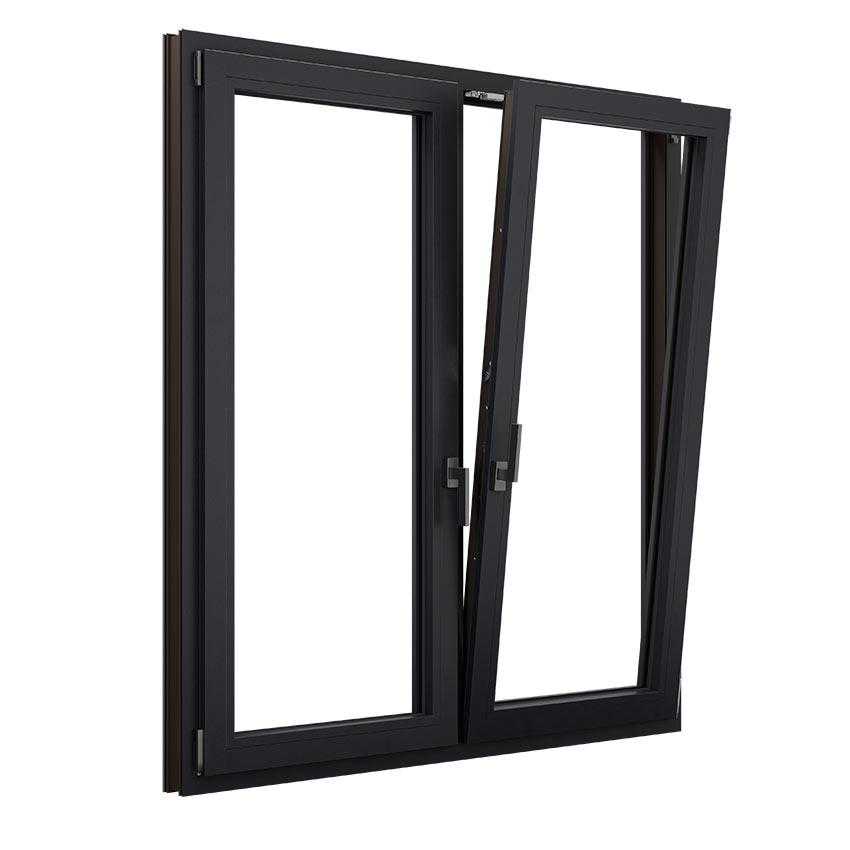
Tilt and Turn Windows: The European Innovation Transforming American Homes
Tilt and turn windows are versatile, European-style windows operating on a dual-hinge system. They tilt inward at the top for secure, draft-free ventilation or swing fully inward like a door for maximum airflow and easy cleaning. Multi-point locking systems and triple-pane glass options deliver superior security and energy efficiency compared to traditional sash or casement designs.
Originally developed in Germany during the 1950s, these windows are increasingly popular in the US, replacing outdated single-hung and double-hung systems in contemporary homes, apartments, and commercial buildings. Independent testing shows 30% better energy efficiency and 3x stronger security than conventional American designs.
This guide explains how they work, why they outperform traditional types, and how to choose the right system for your home.
What Are Tilt and Turn Windows?
These European designs feature a dual-hinge system controlled by a single handle, offering two distinct opening modes in one unit.
The tilt function opens the top inward at a 15-degree angle while the bottom stays securely locked. This creates draft-free ventilation without compromising safety or security.
The turn function swings the entire sash inward from side hinges, like opening a door. This provides maximum airflow and lets you clean both glass surfaces from inside your home.
After becoming the European standard by the 1980s, these systems now represent over 80% of new installations across Germany, Austria, and Switzerland. North American adoption accelerated after 2015 as homeowners discovered their superior performance in energy tests and real-world applications.
How Do Tilt and Turn Windows Work?
The Dual-Hinge System Explained
A single ergonomic handle controls both opening modes. Handle position determines which hinge set engages with the frame.
High-quality European hardware includes steel reinforcement throughout the frame and sash. Multi-point locking mechanisms connect at 5-7 positions around the perimeter, creating an airtight seal when closed.
Three Handle Positions Control Operation
Handle Down (Closed)
The vertical downward position locks all points simultaneously. Steel pins engage corresponding strikes in the frame, creating superior air tightness and water resistance while achieving the best thermal performance and security.
Handle Horizontal (90-Degree Turn)
Rotating 90 degrees to horizontal unlocks the side hinges. The sash swings fully inward from the vertical axis, opening like a door for maximum ventilation and complete cleaning access to exterior glass surfaces from inside.
Handle Up (180-Degree Tilt)
Turning 180 degrees from closed (pointing upward) activates the tilt mechanism. The top tilts inward approximately 15 degrees while the bottom stays locked, creating controlled airflow without fully opening.
Micro-Ventilation Feature
Premium systems include a fourth position at 135 degrees. This creates a 6mm gap around the entire perimeter while keeping all locking points engaged—ideal for overnight ventilation in cold climates with less than 5% heat loss compared to standard ventilation.
Why Choose Tilt and Turn Windows? 5 Performance Advantages
1. Dual Functionality Eliminates Compromise
Traditional designs force you to choose between ventilation types. Single-hung offer limited airflow control. Casement provide full ventilation but lack secure partial opening options.
These European systems (https://oknoplast.us/) deliver both modes in one unit. Tilt for gentle air circulation during mild weather. Turn for rapid room ventilation or emergency egress. This flexibility adapts to changing weather and daily needs without installing multiple types.
2. Superior Energy Efficiency Reduces Costs
Independent testing by Passive House Institute shows U-values as low as 0.14 BTU/hr·ft²·°F with triple glazing—40% better insulation than standard double-hung designs (typical U-value: 0.25-0.30).
Multi-point locking compresses weatherstripping evenly around the entire perimeter, eliminating air leakage common in sliding or hung designs where only 1-2 points create the seal.
Homeowners report 25-30% reduction in heating and cooling costs after replacing single-hung systems. In a 2,000 sq ft home with 15 units, this translates to $300-450 annual savings in moderate climates.
Triple-pane configurations with argon gas fill and Low-E coatings achieve ENERGY STAR Most Efficient status, qualifying for federal tax credits and utility rebates in 43 states.
3. Multi-Point Locking Enhances Security
Standard American designs use 1-2 locking points. Intruders can pry these open in under 30 seconds with basic tools, according to FBI burglary statistics.
These European systems engage 5-7 points simultaneously when closed. Steel reinforcement throughout the frame prevents prying. European RC2 security rating requires resisting forced entry for 3 minutes minimum—sufficient time for alarm response.
The inward-opening design makes it physically impossible to remove from outside. Glass must be broken to gain entry, creating noise and deterring opportunistic burglars. Laminated safety glass options add another protection layer.
4. Easy Interior Cleaning Saves Time
The full inward swing provides complete access to exterior glass surfaces from inside your home, eliminating dangerous ladder work for second-story and higher installations.
Clean both sides in 2-3 minutes per unit. The smooth surface on modern designs contains no exterior tracks or muntins to trap dirt. Rain washes away most debris between manual cleanings.
Property managers report 60% time savings on maintenance compared to traditional hung or casement designs. This benefit compounds in multi-story buildings where exterior access requires scaffolding or lift equipment.
5. Safe Ventilation for Families
The tilt position allows fresh air while preventing falls. Children and pets cannot fit through the 15-degree opening at the top while the bottom remains locked in the frame.
This addresses the 5,000 annual fall injuries reported by the Consumer Product Safety Commission, primarily involving young children near open hung or casement designs. Tilt mode provides continuous ventilation without supervision concerns.
Types of Tilt and Turn Windows: Material Comparison
Three primary materials dominate the North American market, each offering distinct performance characteristics and price points.
uPVC (Vinyl) Systems
Multi-chamber vinyl profiles with steel reinforcement provide the best thermal performance per dollar. Modern uPVC (https://oknoplast.us/windows/upvc-windows/) formulations resist yellowing and maintain structural integrity through temperature extremes from -40°F to 140°F.
Performance Specifications:
- U-value: 0.18-0.22 (double glazed), 0.14-0.16 (triple glazed)
- Lifespan: 30-40 years with minimal maintenance
- Price range: $450-750 per unit installed (standard sizes)
- Maintenance: Wipe with soap and water annually
These achieve Passive House certification more easily than other materials due to superior thermal break capabilities. The material naturally resists moisture, preventing rot, rust, and corrosion common in wood or aluminum.
Best for: Energy-conscious homeowners, northern climates, rental properties requiring low maintenance, budget-focused projects seeking maximum insulation value.
Aluminum Systems
Thermally broken aluminum frames offer the slimmest sightlines and maximum glass area. Powder-coated finishes provide exceptional durability and color retention exceeding 25 years without fading.
Performance Specifications:
- U-value: 0.20-0.26 (requires thermal breaks)
- Lifespan: 40+ years
- Price range: $800-1,400 per unit installed
- Maintenance: Annual inspection of drainage holes
Aluminum excels in high-traffic commercial applications. The material resists warping under stress and maintains tight tolerances across wide spans, making it the preferred choice for floor-to-ceiling installations and curtain wall systems.
Best for: Contemporary architecture, commercial buildings, coastal environments with salt exposure, large openings exceeding 6 feet, projects prioritizing aesthetics over cost.
Wood and Aluminum-Clad Wood Systems
Solid wood or aluminum-exterior/wood-interior configurations appeal to traditional architectural styles and historic renovations. Species selection affects both appearance and performance.
Performance Specifications:
- U-value: 0.19-0.24 (depends on wood species and cladding)
- Lifespan: 25-30 years with proper maintenance
- Price range: $1,200-2,200 per unit installed
- Maintenance: Refinish interior surfaces every 5-7 years
Oak, mahogany, and Douglas fir provide superior structural strength for larger installations. Aluminum cladding on exterior surfaces eliminates wood rot concerns while maintaining traditional interior appearance.
Best for: Historic districts, luxury homes, Craftsman or Victorian architecture, clients prioritizing natural materials, projects requiring specific wood grain aesthetics.
Material Comparison Table
| Feature | uPVC | Aluminum | Wood/Alu-Clad |
| Thermal Performance | Excellent (U: 0.14-0.22) | Good (U: 0.20-0.26) | Very Good (U: 0.19-0.24) |
| Initial Cost | $ | $$$ | $$$$ |
| Maintenance | Minimal | Low | Moderate-High |
| Lifespan | 30-40 years | 40+ years | 25-30 years |
| Color Options | 50+ (throughout) | Unlimited (coating) | Natural + stains |
| Sustainability | Recyclable | Recyclable | Renewable |
| Best Climate | Cold/moderate | Coastal/humid | Moderate/dry |
Tilt and Turn vs Traditional American Windows
Versus Casement Windows
Casement designs open outward on side hinges. This fundamental difference creates multiple performance gaps.
| Feature | Tilt and Turn | Casement |
| Opening Direction | Inward (2 modes) | Outward (1 mode) |
| Ventilation Control | Tilt for draft-free | Full open only |
| Cleaning Access | Both sides from inside | Exterior difficult at height |
| Security | 5-7 locking points | 1-2 locking points |
| Wind Resistance | Excellent (pulls closed) | Poor (pushes open) |
| Screen Placement | Interior (protected) | Exterior (exposed) |
| Space Requirements | Interior clearance | Exterior clearance |
Casement designs create hazards in high-wind events. Outward-opening sashes catch wind and slam repeatedly unless secured. These European systems pull tighter against the frame as wind pressure increases.
Exterior screens on casement designs accumulate dirt and require removal for cleaning. Interior screens stay clean and easily lift out.
Versus Single/Double-Hung Windows
Hung designs dominated American construction from 1950-2010 but suffer from fundamental mechanical limitations.
Traditional hung units slide vertically on tracks or weighted pulley systems. These mechanisms create air gaps and wear points that reduce performance over time.
Key disadvantages:
- Limited ventilation area: Maximum 50% opening (only one sash moves)
- Difficult exterior cleaning: Tilt features still require reaching outside
- Poor weather sealing: Sliding mechanisms cannot compress weatherstripping evenly
- Mechanical failure: Balances break, tracks bend, sashes stick
- Single locking point: Typically one latch at sash meeting rail
These European systems eliminate these issues through rotational opening mechanisms. No sliding parts means no worn tracks. Multi-point compression seals maintain integrity for decades.
Decision Guide: When They Work Best
Choose these European systems for:
- Upper-story bedrooms and bathrooms requiring safe ventilation
- Rooms where children or pets access windows
- Coastal or high-wind locations
- Energy-efficient or Passive House construction
- Properties requiring minimal maintenance
- Areas with noise pollution (traffic, airports)
- Modern or contemporary architecture
Consider traditional designs for:
- Strict historic preservation requirements (pre-1950 replication)
- Extremely tight budgets (basic vinyl hung cost less upfront)
- Shallow interior sill depth (less than 4 inches)
- Spaces where inward swing creates furniture conflicts
Glazing Options Maximize Performance
Glass selection affects 70% of thermal performance. The frame accounts for only 30% of total energy efficiency.
Double vs Triple Glazing
Double Glazing (2 panes):
- Center-of-glass U-value: 0.25-0.28
- 1/2 inch airspace with argon fill
- 20-25% better than single pane
- Cost: baseline
- Best for: Moderate climates (zones 3-4)
Triple Glazing (3 panes):
- Center-of-glass U-value: 0.14-0.18
- Two 1/2 inch airspaces with krypton fill
- 40-45% better than double pane
- Cost: +$150-250 per unit
- Best for: Cold climates (zones 5-7), passive house projects
Triple glazing adds 12-15 pounds per square foot. Verify that hardware specifications accommodate this weight, especially for large installations exceeding 30 square feet.
Low-E Glass Technology
Low-emissivity coatings consist of microscopic metallic layers that reflect infrared radiation, controlling heat transfer while allowing visible light transmission.
Low-E² (double silver coating):
- Blocks 70% of UV radiation
- Allows 60-70% visible light
- Reflects winter heat back inside
- U-value improvement: 0.05-0.08
- Solar Heat Gain Coefficient: 0.27-0.33
Low-E³ (triple silver coating):
- Blocks 84% of UV radiation
- Allows 50-60% visible light
- Superior summer cooling performance
- U-value improvement: 0.08-0.12
- Solar Heat Gain Coefficient: 0.18-0.23
Low-E³ reduces furniture fading by 60-75% compared to standard glass, protecting hardwood floors, artwork, and upholstery from sun damage.
Gas Fills Enhance Insulation
Argon gas fills the space between panes, reducing convective heat transfer. Argon molecules move more slowly than air molecules, decreasing energy flow.
Argon fill:
- U-value improvement: 0.03-0.05
- Cost: +$15-25 per unit
- Standard on most energy-efficient installations
Krypton fill:
- U-value improvement: 0.06-0.09
- Cost: +$60-100 per unit
- Required for 1/4 inch or narrower airspaces
- Necessary for triple-pane passive house performance
Gas fills dissipate 1-2% annually through molecular permeation. Quality units maintain 80%+ gas retention after 20 years. Check manufacturer specifications for seal warranties.
Laminated Safety Glass
Two glass sheets bond to a plastic interlayer (typically PVB or EVA), preventing shattering and providing additional benefits.
Security applications:
- Resists forced entry (glass doesn’t break cleanly)
- Holds fragments if broken (prevents injury)
- Available in 0.030″ to 0.120″ interlayer thickness
Sound reduction:
- Cuts noise by 3-5 STC points
- Mass-loaded vinyl interlayers achieve STC 36-42
- Effective against traffic, aircraft, train noise
Hurricane protection:
- Impact-rated laminate passes large missile tests
- Florida Building Code approval (high-velocity hurricane zones)
- Eliminates need for storm shutters in many applications
Acoustic Insulation for Noise Control
Standard units achieve STC (Sound Transmission Class) ratings of 26-28, barely reducing normal conversation volume.
Specialized acoustic glazing reaches STC 38-42 through asymmetric glass thickness and lamination. A 1/4″ outer pane + 5/16″ inner pane configuration disrupts sound wave resonance more effectively than equal thickness panes.
Real-world noise reduction examples:
- STC 28: Loud conversation easily understood through glass
- STC 35: Loud conversation reduced to murmur
- STC 40: Loud conversation barely audible
- STC 45: Shouting reduced to whisper level
Properties near highways, airports, or railways benefit from STC 40+ glazing. The upgrade costs $150-300 per unit but eliminates 70-80% of exterior noise pollution.
Energy Efficiency and Cost Savings
Understanding U-Values and R-Values
U-value measures heat flow rate through a material. Lower numbers indicate better insulation. European standards use metric (W/m²·K). American standards use imperial (BTU/hr·ft²·°F).
U-value ranges:
- Basic double glazing: 0.28-0.32
- High-performance double: 0.22-0.26
- Standard triple: 0.18-0.22
- Passive house triple: 0.14-0.16
R-value represents thermal resistance (inverse of U-value). Calculate: R = 1 ÷ U-value. Higher R-values mean better insulation.
A unit with U-value 0.20 has R-value 5.0, matching a standard 2×4 wall with fiberglass insulation (R-13 to R-15 when accounting for studs and gaps).
Energy Cost Analysis
A typical 2,400 sq ft home in Chicago contains approximately 180 sq ft of glass area. Replacing 28-year-old aluminum-frame units (U-value 0.85) with modern systems (U-value 0.18) produces measurable savings.
Annual heating energy loss (old):
- 180 sq ft × 0.85 U-value × 6,500 heating degree days × 24 hrs = 23.8 million BTU
- At $1.20/therm natural gas: $286 annual loss
Annual heating energy loss (new):
- 180 sq ft × 0.18 U-value × 6,500 heating degree days × 24 hrs = 5.0 million BTU
- At $1.20/therm natural gas: $60 annual loss
Annual savings: $226 on heating alone. Add cooling savings (15-20% reduced AC load) for total annual benefit of $270-310.
Payback calculation:
- Average replacement: $850/unit × 12 units = $10,200
- Annual savings: $290
- Simple payback: 35 years
- With 30% federal tax credit: $7,140 net cost = 24.6 year payback
- Including increased home value: 5-8 year effective payback
ENERGY STAR and Passive House Certification
ENERGY STAR certification requires:
- Northern zone: U-value ≤ 0.27, SHGC ≤ 0.40
- North-Central: U-value ≤ 0.28, SHGC ≤ 0.40
- South-Central: U-value ≤ 0.30, SHGC ≤ 0.25
- Southern: U-value ≤ 0.40, SHGC ≤ 0.25
Premium systems exceed these requirements by 35-50%, qualifying for ENERGY STAR Most Efficient designation and utility rebates averaging $75-150 per unit.
Passive House Institute certification demands:
- Installed U-value ≤ 0.85 W/m²·K (0.15 BTU/hr·ft²·°F)
- Air leakage ≤ 0.6 ACH50
- Thermal bridge-free installation
Only triple-glazed systems with thermally broken frames meet these standards. Passive House buildings consume 75-90% less energy than conventional construction.
Security Features Protect Your Home
Multi-Point Locking Systems
Standard hardware engages 5 locking points on smaller installations (under 20 sq ft) and 7 points on larger units. Each point contains a steel mushroom-shaped cam that hooks behind a strike plate in the frame.
When you turn the handle to closed position, all cams engage simultaneously. This distributes force evenly and prevents prying at any single point. Intruders would need to defeat multiple locks simultaneously—a task requiring specialized tools and 3+ minutes.
Compare this to single-hung designs with one latch. Burglars defeat these in 10-15 seconds with a flathead screwdriver.
RC Ratings Quantify Break-In Resistance
European RC (Resistance Class) standards test units against specific attack methods and durations.
RC1 (Basic Security):
- Resists 3 minutes of kicking, pulling, prying
- Standard hardware achieves this without upgrades
- Deters opportunistic burglars with no tools
RC2 (Enhanced Security):
- Resists 3 minutes of attack with screwdrivers, pliers, wedges
- Requires upgraded glazing (laminated) and reinforced hardware
- Recommended for ground-floor units and accessible locations
- Costs +$150-200 per unit vs standard
RC3 (High Security):
- Resists 5 minutes of attack including pry bars and drills
- Requires specialized frame reinforcement and 0.060″ laminated glass
- Primarily used in commercial or high-risk residential applications
FBI statistics show 60% of burglars abandon attempts when entry takes longer than 90 seconds. RC2-rated systems exceed this threshold by 100%.
Impact Ratings for Hurricane Zones
Florida Building Code defines three impact ratings for hurricane protection:
Large Missile Test (Level D):
- 9-pound 2×4 lumber projectile at 50 feet/second
- Simulates debris in 170+ mph winds
- Required for openings within 30 feet of grade in high-velocity zones
Small Missile Test (Level E):
- 10 steel ball bearings at 80 feet/second
- Simulates gravel and small debris
- Required for elevated openings in hurricane zones
Impact-rated units pass these tests while maintaining operational capability. Multi-point locking keeps the sash locked in the frame even when glass cracks, preventing wind-driven rain penetration.
Standard impact glazing costs $45-75 per square foot but eliminates the need for hurricane shutters ($15-35/sq ft) that require installation before each storm.
Installation and Maintenance Requirements
Professional Installation Ensures Performance
These European systems require different installation methods than traditional American designs. The heavy sash weight (30-60 pounds for standard sizes) and multi-point locking system demand precise alignment.
Critical installation steps:
- Square opening verification: Maximum diagonal variance 1/8 inch
- Shimming and leveling: Use solid shims every 12 inches around perimeter
- Weatherproofing: Apply flexible flashing to head and jambs before setting unit
- Expansion gap: Maintain 1/4 inch gap around frame perimeter for seasonal movement
- Anchor spacing: Secure frame with anchors every 12-16 inches
- Foam application: Low-expansion foam only (max 25% expansion) to prevent frame distortion
Improper installation causes 70% of performance complaints. Overtightened anchors bow the frame, preventing proper lock engagement. Insufficient shimming allows sagging, creating air gaps.
Expect professional installation to cost $150-300 per unit depending on opening condition and access difficulty. DIY installation risks voiding manufacturer warranties.
Maintenance Procedures Extend Lifespan
These systems require minimal maintenance but benefit from annual inspection.
Annual maintenance checklist (30 minutes total):
- Clean frame and sash with mild soap solution
- Lubricate locking points with silicone spray (not oil-based)
- Lubricate hinges with lithium grease
- Check and clean weep hole drainage channels
- Inspect weatherstripping for compression or damage
- Test all handle positions for smooth operation
- Clean glass with standard cleaner
Every 5 years:
- Adjust hardware if needed (handle resistance increases slightly)
- Replace weatherstripping if visible wear appears
- Re-lubricate all moving parts
Properly maintained units operate smoothly for 30+ years without hardware replacement. The lack of sliding mechanisms eliminates the track wear and balance failures common in hung designs.
Common Issues and Solutions
Handle won’t rotate to next position:
- Cause: Sash not fully closed before turning handle
- Solution: Push sash firmly into frame, verify all locking points engage, then rotate handle
Sash doesn’t close tightly (air gap visible):
- Cause: Hinge screws loosened over time
- Solution: Tighten hinge screws with #3 Phillips screwdriver (do not overtighten)
Condensation between glass panes:
- Cause: Seal failure allowing moisture infiltration
- Solution: Contact manufacturer for glass unit replacement under warranty (typically 10-20 years)
Squeaking during operation:
- Cause: Dry hinges or inadequate lubrication
- Solution: Apply lithium grease to hinge pins annually
Sash sags when opened (bottom corner drops):
- Cause: Worn hinge or loose mounting screws
- Solution: Replace hinge assembly (requires professional service for proper alignment)
Customization Options Match Any Design
Frame Colors and Finishes
Modern manufacturing allows nearly unlimited color options across all materials.
uPVC color options:
- Standard white (included in base price)
- Cream, beige, gray, brown (add $45-75 per unit)
- Woodgrain foils in oak, walnut, mahogany patterns ($85-120 per unit)
- Metallic finishes: anthracite gray, black, bronze ($95-140 per unit)
- Dual colors: exterior/interior different ($150-200 per unit)
Color selection affects more than aesthetics. Dark exterior colors absorb more solar radiation, increasing frame temperature by 20-30°F on sunny days. This accelerates thermal expansion and can stress the frame. Manufacturers limit dark colors to specific frame systems with adequate thermal expansion allowances.
Aluminum color options:
- Anodized finishes: silver, bronze, black (standard)
- Powder coating: unlimited RAL color range ($120-180 per unit)
- Wood-look powder coating with grain texture ($200-280 per unit)
Wood finishes:
- Clear coat with natural grain (shows wood species)
- Stains: light oak, medium walnut, dark espresso, custom match
- Painted: any color (exterior typically aluminum-clad, no maintenance)
Hardware and Handle Styles
Handle design affects both aesthetics and ergonomics. Premium handles include locking mechanisms for added security.
Standard handle options:
- Contemporary: Brushed stainless steel or matte black (included)
- Traditional: Polished brass or oil-rubbed bronze (add $25-40 per unit)
- Minimalist: Flush-mount designs that sit flat when closed ($45-65 per unit)
Locking handle upgrades:
- Push-button lock: Prevents operation when button not pressed ($35-50 per unit)
- Keyed lock: Requires key to rotate handle ($55-85 per unit)
- Both prevent children from opening unsupervised
Handle height affects accessibility. Standard installation places handles 36-42 inches from floor. ADA-compliant installations use extended handles or place them 24-30 inches high for wheelchair access.
Grid Patterns and Divided Lites
Interior grids create traditional appearance without affecting thermal performance. Grids sit between glass panes, maintaining smooth interior and exterior surfaces for easy cleaning.
Common grid patterns:
- Colonial: 6-over-6 or 8-over-8 rectangular pattern
- Prairie: Perimeter grid with 4 corner rectangles
- Farmhouse: 3-over-1 with larger bottom pane
- Custom: Any pattern to match existing home design
Grids add $75-150 per unit depending on complexity. Each grid intersection creates slight visual distortion in the glass view. Consider grid necessity carefully for picture installations where unobstructed views matter.
Simulated divided lite (SDL) option: Exterior aluminum bars attach to glass surface, creating authentic divided lite appearance from outside. Interior remains smooth single-pane glass. This suits historic renovations requiring period-accurate exterior appearance while maintaining modern performance.
Custom Shapes and Sizes
The mechanism adapts to various shapes beyond standard rectangles.
Available configurations:
- Rectangles: Any width-to-height ratio (structural limits apply)
- Arched top: Semicircular or elliptical arch with operating sash below
- Trapezoid: Angled top or sides following roofline
- Triangle: Typically fixed units, not operable
- Circles: Fixed only, diameter up to 72 inches
Size limitations by material:
| Material | Max Width | Max Height | Max Area |
| uPVC | 48 inches | 84 inches | 24 sq ft |
| Aluminum | 72 inches | 96 inches | 48 sq ft |
| Wood | 60 inches | 84 inches | 32 sq ft |
Larger openings require multiple units with mullions (vertical dividers between units). Mullions add $200-350 per location but maintain structural integrity for oversized installations.
Cost Analysis and Return on Investment
Price Ranges by Type
Actual installed costs vary by region, opening condition, and order quantity. These ranges reflect 2026 national averages for standard sizes (30″ × 60″).
uPVC systems:
- Standard double-glazed: $650-850 installed
- High-performance double: $750-950 installed
- Triple-glazed: $850-1,100 installed
- Passive House certified: $1,000-1,300 installed
Aluminum systems:
- Standard double-glazed: $1,100-1,450 installed
- High-performance double: $1,300-1,650 installed
- Triple-glazed: $1,500-1,900 installed
Wood/aluminum-clad:
- Standard double-glazed: $1,600-2,100 installed
- High-performance double: $1,850-2,350 installed
- Triple-glazed: $2,100-2,700 installed
Larger installations increase cost proportionally to square footage. A 48″ × 72″ unit (24 sq ft) costs approximately 2.5× more than a 30″ × 60″ unit (12.5 sq ft) due to structural reinforcement requirements.
Comparing Costs to Traditional Designs
Standard vinyl double-hung:
- $350-550 installed (same size)
- Difference: +$300-500 for tilt and turn
Aluminum casement:
- $750-1,050 installed
- Difference: +$350-600 for tilt and turn
Wood double-hung:
- $900-1,400 installed
- Difference: +$700-1,300 for tilt and turn
The initial cost premium ranges from 40% (vinyl) to 65% (wood). This gap narrows when accounting for total lifecycle costs.
30-year total cost of ownership comparison:
| Type | Initial Cost | Energy Cost | Maintenance | Total |
| Double-hung vinyl | $500 | $2,400 | $800 | $3,700 |
| Casement aluminum | $900 | $2,100 | $600 | $3,600 |
| Tilt/turn uPVC | $850 | $1,650 | $300 | $2,800 |
Lower energy costs and minimal maintenance make these European systems more economical over 20+ year ownership periods.
Resale Value Impact
National Association of Realtors data shows replacement projects return 68-78% of cost at resale. Premium installations can exceed 85% return in energy-conscious markets.
Home value increase factors:
- Energy efficiency certification (Passive House, LEED): +1.5-2.5% home value
- Modern, low-maintenance materials: +1.0-1.5% home value
- Enhanced security features: +0.5-1.0% home value
- Noise reduction (urban properties): +1.0-2.0% home value
A $400,000 home with $15,000 investment can see $6,000-12,000 appraised value increase. Combined with annual energy savings, effective payback occurs in 5-8 years for most homeowners.
Energy-efficient homes sell 20% faster than comparable properties in the same neighborhood, according to Department of Energy market studies. This velocity benefit compounds the financial return.
 Ask Ireneia Diamondolls how they got into home repair tips and you'll probably get a longer answer than you expected. The short version: Ireneia started doing it, got genuinely hooked, and at some point realized they had accumulated enough hard-won knowledge that it would be a waste not to share it. So they started writing.
What makes Ireneia worth reading is that they skips the obvious stuff. Nobody needs another surface-level take on Home Repair Tips, Creative Concepts, DIY Renovation Ideas. What readers actually want is the nuance — the part that only becomes clear after you've made a few mistakes and figured out why. That's the territory Ireneia operates in. The writing is direct, occasionally blunt, and always built around what's actually true rather than what sounds good in an article. They has little patience for filler, which means they's pieces tend to be denser with real information than the average post on the same subject.
Ireneia doesn't write to impress anyone. They writes because they has things to say that they genuinely thinks people should hear. That motivation — basic as it sounds — produces something noticeably different from content written for clicks or word count. Readers pick up on it. The comments on Ireneia's work tend to reflect that.
Ask Ireneia Diamondolls how they got into home repair tips and you'll probably get a longer answer than you expected. The short version: Ireneia started doing it, got genuinely hooked, and at some point realized they had accumulated enough hard-won knowledge that it would be a waste not to share it. So they started writing.
What makes Ireneia worth reading is that they skips the obvious stuff. Nobody needs another surface-level take on Home Repair Tips, Creative Concepts, DIY Renovation Ideas. What readers actually want is the nuance — the part that only becomes clear after you've made a few mistakes and figured out why. That's the territory Ireneia operates in. The writing is direct, occasionally blunt, and always built around what's actually true rather than what sounds good in an article. They has little patience for filler, which means they's pieces tend to be denser with real information than the average post on the same subject.
Ireneia doesn't write to impress anyone. They writes because they has things to say that they genuinely thinks people should hear. That motivation — basic as it sounds — produces something noticeably different from content written for clicks or word count. Readers pick up on it. The comments on Ireneia's work tend to reflect that.